
India's single monthly statement: what the new CAS covers
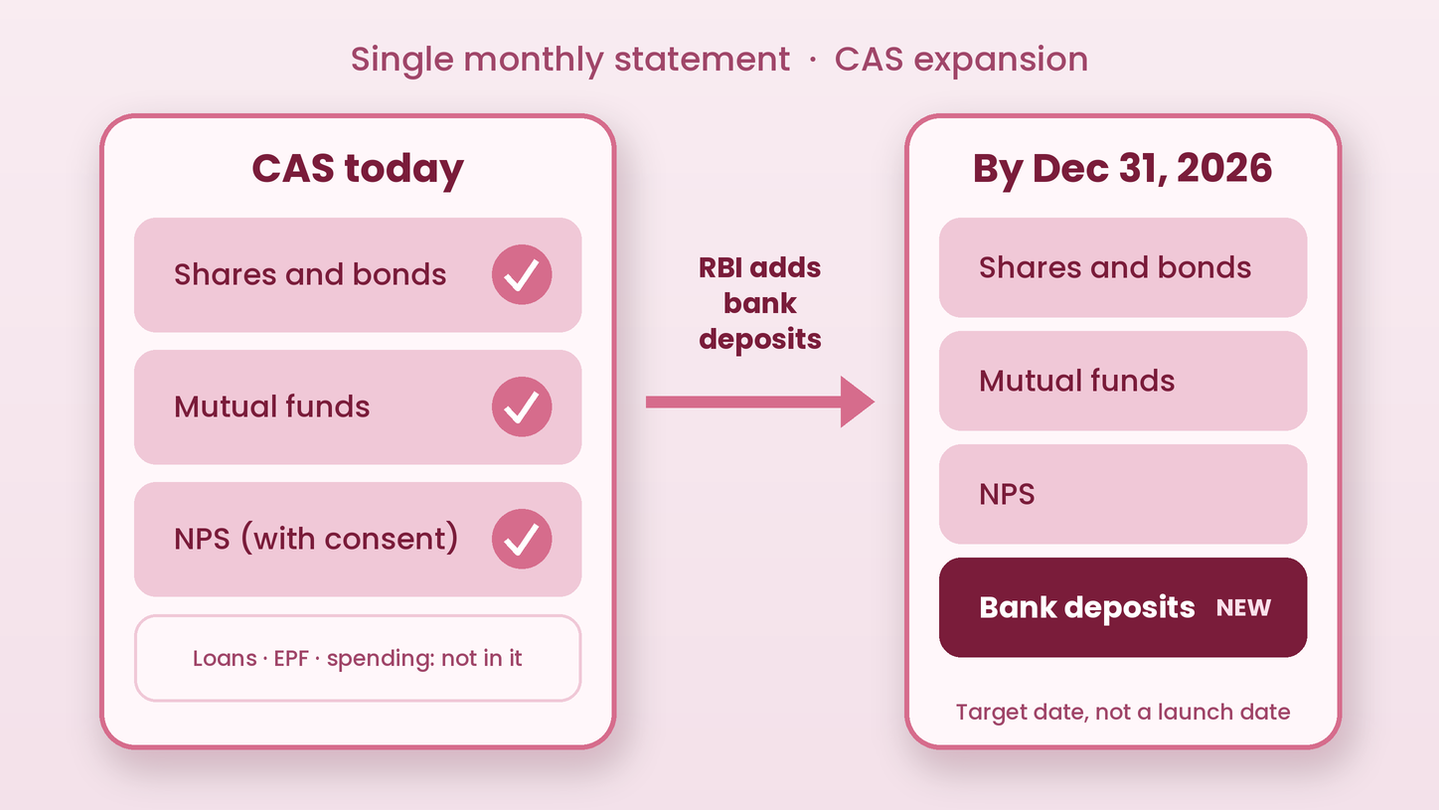
RBI wants bank deposits inside the Consolidated Account Statement by December 31, 2026. Here's what that single monthly statement will and won't show, what is still unclear, how to get your CAS today, and what to track beyond it.
India's single monthly statement is the Consolidated Account Statement (CAS), which RBI is expanding to add bank deposits beside your shares, mutual funds and NPS by December 31, 2026. It won't show your spending or EMIs. Kedil, a budgeting app for salaried Indians, covers those by importing your bank statement PDF.
The statement is built for investments, while tracking your accounts, cards and loan EMIs is a different job, one I cover in Track Your Bank Accounts, Credit Cards, and Loan EMIs Without a Spreadsheet. Both jobs matter if you want a true picture of where you stand. This guide separates what RBI has confirmed from what is still unclear, as of 24 November 2026.
I've spent 15+ years in financial infrastructure, mostly disaster recovery and business continuity, and I build Kedil. The first rule in recovery work is one inventory of everything that exists. Personal finance tracking needs the same: one list of what you own and what you owe. This guide covers what the single monthly statement shows today, what the expansion adds, how Account Aggregator consent works, how to get your CAS, and what to track beyond it.
| What you want to see | CAS today | Expanded CAS (expected by Dec 31, 2026) | Bank statement PDF |
|---|---|---|---|
| Shares and bonds in demat | Yes | Yes | No |
| Mutual funds | Yes | Yes | Only SIP debits |
| NPS | Yes, with your consent | Yes | Only contributions |
| Bank deposits | No | Yes, details still being finalised | Yes, per bank |
| EPF | No | Not announced | Only if credited |
| Loans and EMIs | No | Not announced | Yes, EMI debits |
| Monthly spending and UPI | No | No | Yes |
What is India's single monthly statement?
India's single monthly statement is the Consolidated Account Statement, or CAS. One document, tied to your PAN, that brings your market investments together instead of leaving them in separate apps and emails. The new part is that RBI wants it to include bank deposit information too.
The consolidated account statement today
SEBI mandated the CAS through a circular dated November 12, 2014, and depositories started issuing it from March 2015, according to CDSL's FAQ. It is issued by the depositories NSDL and CDSL and shows holdings and transactions across your demat accounts, plus mutual fund units held outside demat.
Zerodha Varsity lists what it covers now: stocks across all your demat accounts, mutual funds, government and corporate bonds in demat, and NPS if you give explicit consent through the NPS record-keeping agency's website. It also shows SIP transactions, redemptions, switches and your nomination status.
What RBI added in October 2026
On October 7, 2026, RBI Governor Sanjay Malhotra announced that SEBI-regulated depositories would be facilitated to include bank deposit information in the CAS through NBFC Account Aggregators. In the same announcement, RBI said Account Aggregators would become interoperable, so you can reach data held by different providers through one aggregator of your choice.
The change is about bringing information together. As NewsBytes put it, your deposits stay with your bank, and no money moves.
Why a single monthly statement matters
Money held across banks, brokers and fund houses is hard to see as one thing. Zerodha Varsity describes how managing investments gets chaotic when you use different brokers or invest through several apps, which is the gap the CAS fills. 5paisa adds a practical reason cited with the RBI move: deposits can be traced more easily after an account holder's death. That makes the single monthly statement useful for families, not only for investors who like dashboards.
When does the new statement start?
RBI's target is to implement this by December 31, 2026. Business Today and Outlook Money both report that date. Some news reports, including UNI and 5paisa, describe it as starting from January 1.
I'd read that as a target, not a launch date. Zerodha Varsity says the same: it is an expectation, not a confirmed launch. Expect rollout in stages rather than every bank appearing in your statement on day one, since 5paisa notes that only banks already connected to the system will be included at first.
What the single monthly statement will and won't show
The headline is simple, and the details are not. RBI's announcement was a policy direction, and several details depend on a framework that was not published when I checked.
What is confirmed
- Depositories can add bank deposit account information to the CAS
- The data moves through NBFC Account Aggregators, with your consent
- Aggregators will become interoperable, so you choose which one to use
- People without a demat account can still get a consolidated view of their financial information through an Account Aggregator
- The target date for implementation is December 31, 2026
In plain terms, the single monthly statement will grow from a market-investments document into one that also reflects bank deposits, but only for the accounts and banks the framework covers, and only with your consent. That is a real step for personal finance tracking, and it is a smaller step than some headlines suggest.
What is still unclear
Business Today and Outlook Money both flag open questions. It is unclear whether "deposit accounts" means only fixed deposits or also savings accounts, even though some explainers say both. RBI has not said every bank account will automatically appear in every CAS. The articles also don't define which deposits are eligible, how you grant or withdraw consent, or whether people without a demat account will see deposits inside a CAS or only through an aggregator.
If you read an article that gives exact steps or says your savings account will definitely appear, treat it with caution. Wait for the final framework.
What it won't show: loans, EPF and spending
A bigger idea is being discussed, but it is not part of the October announcement. In January 2026, Business Standard reported that SEBI had started talks with RBI and IRDAI on a statement that could cover savings, provident fund, insurance, bonds and outstanding loans. Outlook Money added that the SEBI chairman said it may stay optional, and no timeline was given.
So for now, assume the expanded CAS will not show your home loan, car loan, personal loan or credit card dues. It won't show EPF. And it will never show your monthly spending, because a statement of holdings is not a record of what you spent.
How Account Aggregator consent works
The deposit data comes through the Account Aggregator framework, so it helps to know how that works before you click "approve" on anything.
Account Aggregators in plain words
Account Aggregators are RBI-regulated NBFCs that move your financial data between institutions. The institution that holds the data is the Financial Information Provider, and the one that receives it is the Financial Information User. The aggregator carries the data but does not decide who gets it.
The system is large. As of August 2026, about 338 million accounts were linked, and there were 17 licensed aggregators, according to 5paisa and The420. Cumulative fulfilled consents had reached 566.26 million.
Consent is per transfer
Each transfer needs your explicit authorisation, as The420 explains. That is the design principle: data moves when you permit it, not before. It means the single monthly statement should not quietly pull in accounts you never approved.
What to check before you approve
Experts quoted by The420 say people should know what data is shared, who receives it and why, and should have a simple way to withdraw consent. Before approving any request, I'd check:
- Who is asking for the data, and for what purpose
- Which accounts and what period it covers
- How long the consent lasts
- Where you go to review or withdraw it later
CAS or Account Aggregator: which one do you use?
They are not the same thing. The CAS is a document you receive or download. The Account Aggregator is the consent pipeline that lets data flow to it and to other apps. NewsBytes reports that the upgraded CAS is meant to work with Account Aggregator apps, so you can check your financial information wherever it is most convenient. People without a demat account can use an aggregator route instead of waiting for a CAS.
How to get your CAS today
You don't need to wait for the expansion. The current consolidated account statement is useful on its own, and the habit of reading it will carry over. Here is how to get your CAS whichever way you invest.
If you have a demat account
NSDL and CDSL issue the CAS, usually by email. It arrives monthly if you had a transaction in any demat account or mutual fund folio, and half-yearly if you had none. In the half-yearly case, per the CDSL FAQ, holdings at the end of March and September are sent in April and October.
If you hold accounts with both depositories, the one where your older demat account sits is the default issuer, according to share.market. Search your inbox for "CAS", "NSDL" or "CDSL".
If you only hold mutual funds
Without a demat account, your mutual fund registrar, CAMS or KFintech, sends a mutual-fund-only CAS. You can request it through their portals or through MFCentral. Lemonn points out that the depository CAS and the registrar CAS are two different statements that share a name, which causes a lot of confusion.
Generate it on demand
You don't have to wait for the monthly email. Share.market says you can generate a CAS on demand through NSDL, CDSL or MFCentral, for the current or previous financial year or a custom period up to 365 days. Zerodha's support page also lists DigiLocker as an option: log in, search for CDSL and pick the Consolidated Account Statement.
A step-by-step routine:
- Open the NSDL, CDSL or MFCentral site and verify with your PAN and the email or mobile registered with your account
- Choose the period you want, up to 365 days
- Download the PDF
- Save it in one folder, named by month
- Compare the total with last month
Common mistakes when reading your CAS
- Mixing up the depository CAS and the registrar CAS, which are two different statements with the same name
- Expecting it to work out capital gains, when it shows quantity and current value but not cost
- Forgetting that holdings-only statements come twice a year if you had no transactions
- Treating it as a tax working, when share.market says it is a transaction trail and not a replacement for AIS or Form 26AS
Five ways the single monthly statement helps
Business Today listed five ways the expansion could help. I've rewritten them for a salaried household, with my own view added.
A net worth view in one place
Today a fixed deposit sits in one bank app, mutual funds in another and shares with a broker. With deposits in the CAS, the total is on one page. For a household that has built savings over ten years across banks, that alone saves an afternoon of logging in. Net worth is simply what you own minus what you owe, so a view of the assets side is half the sum, and the loans side has to come from elsewhere.
A check on interest income and tax
Consolidated deposit data could help you check the interest you earned against Form 26AS and the AIS. Business Today says to treat the CAS as an extra check, not a replacement for those forms. I agree. Lemonn adds that the depository CAS shows quantity and current value but not your cost of acquisition, so it can't compute capital gains either.
A nomination check
The CAS already shows nomination status for the investments it covers. With deposits added, you could see whether your FDs have a nominee on record. Business Today notes that a nominee is not the legal owner of an FD, but nomination can help with transfer or settlement after the holder's death. Whatever the new statement shows, go and check your nominations this month.
A review of how your savings are split
Seeing deposits and market investments side by side shows whether you hold too much in FDs or too little in equity. Zerodha Varsity notes that the CAS does not itself give an asset allocation, so you do that arithmetic yourself.
A way to spot items you don't recognise
An account or holding you can't place could signal an error, outdated records or unauthorised activity, as Business Today points out. A monthly look at the statement is a cheap way to catch it early.
Who gains most from the single monthly statement
In my view, the biggest winners are salaried households with savings spread across several banks: a fixed deposit opened at one bank, a recurring deposit at another, mutual funds through a third app. If you hold everything in one bank and one fund house, you already have one view and the change adds little. The more accounts you have, the more the single monthly statement is worth.
Why one statement is not your whole personal finance picture
A statement of holdings tells you what you own. It says nothing about what you owe or what you spend, and for a salaried household with EMIs those are the larger story. Good personal finance tracking needs both halves.
What the CAS leaves out: EMIs and spending
Take a household with ₹80,000 a month take-home pay. The table below uses made-up figures to show what the CAS view misses.
| Item | In the CAS? | Amount |
|---|---|---|
| Fixed deposits | Yes, after the expansion | ₹3,50,000 |
| Mutual funds | Yes | ₹5,20,000 |
| NPS | Yes, with consent | ₹1,10,000 |
| EPF balance | No | ₹4,80,000 |
| Personal loan outstanding | No | ₹2,40,000 |
| Car loan outstanding | No | ₹3,10,000 |
The CAS view shows ₹9.8 lakh of assets. The real net worth is ₹14.6 lakh of assets minus ₹5.5 lakh of loans, which is ₹9.1 lakh. The statement is accurate about what it covers. It is just not the whole story.
Where your EMIs and spending actually live
Your EMIs and daily spending sit in bank and card statements, not in the CAS. The loan statements are scattered across lenders, the monthly debits sit in one or two bank accounts, and credit card dues arrive in a third place. None of it will be in the single monthly statement for the foreseeable future.
That matters because of what gets you into trouble. You rarely run into a problem because your mutual fund balance is unknown. You run into one because the EMIs and the rent leave too little by the 20th.
Tracking the rest of your money with Kedil
A good monthly review uses two sources: the CAS for what you own, and your bank statements for what you earn, spend and owe. Kedil handles the second.
Import your bank statement PDF
The Bank Statement Analyzer reads your bank statement PDF, so you don't type transactions or convert files to CSV. If your salary lands in one account and your EMIs leave from another, Manage Multiple Bank Accounts keeps them in one view.
Kedil is not an investment app. It covers the part the CAS leaves out: what came in, what went out and which loans are still running.
Get ready before December 31
You can prepare now, without waiting for the final framework:
- Make sure the email and mobile number registered with your demat and mutual fund accounts are current
- List every fixed and recurring deposit you hold, with the bank name
- Check the nominee on each deposit and investment
- Note which of your accounts are linked to which PAN
- Collect your loan statements in one folder
When the single monthly statement does arrive, you'll be able to check it against your own list instead of trusting it blindly.
A 15-minute monthly money review
Once a month, ideally right after salary day, do this:
- Download the latest CAS and note the total of your investments
- Import your bank statements and check your spending against your plan
- Update your loan balances in the Debt Management App and note how much principal you cleared
- Check that nominations and registered emails are still correct
- Write one decision for next month
If you keep a record of your savings rate each month, as in our guide to the good savings rate in India, the CAS gives you the investment total and your bank statement gives you the income side.