
How to invest in SWP: a step-by-step guide for salaried Indians
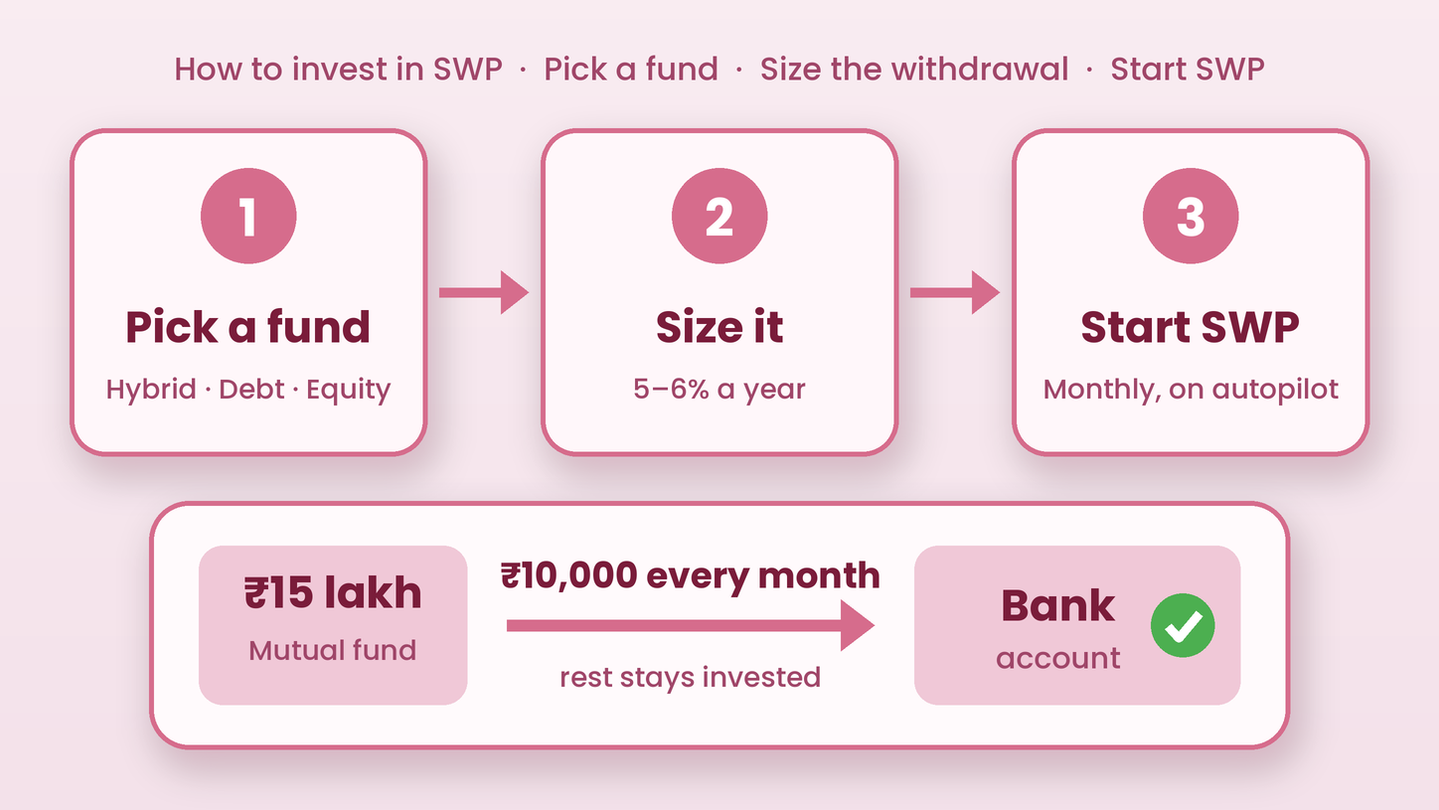
Most guides treat SWP like a product you buy. It isn't. You pick a fund, size a withdrawal your corpus can survive, and set it up in ten minutes. Here's the maths, the 2026 tax rules and the mistakes salaried Indian families make along the way.
To invest in SWP, you put a lump sum, or units you already built through SIPs, into a mutual fund and then register a Systematic Withdrawal Plan that sells a few units on a fixed date and credits a set amount to your bank. New to the idea? Read What is SWP first. Kedil, a personal budgeting app for salaried Indians, reads bank statement PDFs so you can size that amount from real spending.
Here's the catch most guides skip. You don't really invest in SWP. You invest in a fund, and SWP is a withdrawal instruction on top of it. So the two decisions that matter are which fund holds the money and how much you pull out each month. Get those right and the setup itself takes ten minutes on an AMC app.
I've spent 15+ years in financial infrastructure and I build Kedil, so I look at an SWP the way I look at any system: inputs, failure modes, and what breaks first. This guide walks through how to invest in SWP in 2026, how to start SWP online, how SWP tax works for equity and debt funds, which funds suit which runway, and the withdrawal-rate maths that decides whether your corpus lasts 12 years or 40.
| What you decide | Your options | What I'd pick for a household SWP |
|---|---|---|
| Source of money | Fresh lump sum, or existing SIP units | Existing units older than 12 months |
| Fund category | Liquid, debt, hybrid, equity | Balanced advantage or conservative hybrid |
| SWP withdrawal rate | 4% to 12% of corpus a year | 5–6% if it must last 20+ years |
| Frequency | Monthly, quarterly, half-yearly, annual | Monthly, a few days after salary credit |
| Type | Fixed amount or appreciation only | Fixed amount, reviewed every April |
| Start date | Any date the AMC offers | After the exit load period ends |
What it really means to invest in SWP
An SWP is the reverse of a SIP. A SIP buys units every month. An SWP sells them. When you invest in SWP, the money sits in a normal mutual fund folio, and the SWP instruction tells the fund house to redeem enough units each cycle to pay you a fixed rupee amount.
How an SWP in mutual fund schemes works, unit by unit
Say your folio holds 30,000 units and the NAV is ₹50. You set a ₹10,000 monthly SWP in mutual fund terms. On the SWP date, the fund sells 200 units (₹10,000 ÷ ₹50) and sends the money to your bank. Next month the NAV is ₹52, so it sells about 192 units. The rest keep earning.
- Higher NAV means fewer units sold for the same payout
- Lower NAV means more units sold, which is the part that drains a corpus in a bad year
- Each instalment is a separate redemption, so exit load and tax are checked every time
- Units are sold first-in, first-out, so your oldest units go first
SWP for monthly income vs a SIP: two ends of one plan
Most salaried people in Chennai or Coimbatore don't need an SWP for monthly income today. Your salary does that job. What you need is the SIP that builds the corpus. The SWP comes later: at retirement, during a career break, or to fund a fixed outflow like a parent's monthly allowance.
That's why I'd treat the decision to invest in SWP as a planning step, not a product purchase. You can start SWP on the same fund your SIP has been feeding for years. No new folio needed.
Who should invest in SWP now, and who should wait
If you're 32, salaried, with a home loan and two kids in school, you probably shouldn't invest in SWP for yourself yet. Your job is to keep the SIP running. But there are real cases where a salaried household should invest in SWP today:
- You received a lump sum, such as a bonus, an inheritance or a maturing policy, and want it to pay a fixed bill every month
- You support parents who have no pension and want their allowance to arrive on autopilot
- You're planning a sabbatical or a move to a lower-paying job and need 12–24 months of top-up income
- You're within five years of retirement and want to test an SWP in mutual fund form on a small amount first
If none of these fit, keep building the corpus. Learning how to invest in SWP now still helps, because it tells you how big that corpus needs to be.
Before you invest in SWP: size the withdrawal
Nearly every SWP that fails was sized from a guess. Someone picks ₹25,000 because it sounds right, and the corpus runs dry in year 11. Do the numbers first.
Find the SWP for monthly income your household actually needs
Start with what your house really spends, not what you think it spends. Pull three months of bank statements and add up rent, groceries, school fees, insurance premiums, EMIs, and the leaks you forget. If you've never done this, Where does all my money go shows where salaried pay usually disappears.
Then decide what the SWP must cover. An SWP for monthly income rarely needs to fund the whole household. It might cover:
- Your parents' ₹12,000 monthly allowance
- School fees, as a quarterly SWP timed to the fee dates
- A six-month career break, topped up by savings
- The gap between a pension and actual retirement spending
Uploading statement PDFs to the bank statement analyzer gives you that monthly figure in categories, without a spreadsheet.
Pick a safe SWP withdrawal rate
Your SWP withdrawal rate is the yearly payout divided by the corpus. ₹10,000 a month from ₹15 lakh is ₹1.2 lakh a year, an 8% SWP withdrawal rate. That single number decides how long the money lasts.
My rule: if the money has to last 20+ years, keep the SWP withdrawal rate at 5–6%. If it only has to cover a 5–7 year gap, you can go higher, because running the corpus to zero is the plan.
SWP withdrawal rate vs how long ₹15 lakh lasts
I ran ₹15 lakh at a steady 7% a year, roughly what a hybrid fund might average. Real returns jump around, so treat this as direction, not a promise.
| Monthly SWP | SWP withdrawal rate | How long ₹15 lakh lasts at 7% |
|---|---|---|
| ₹6,000 | 4.8% | 50+ years, corpus keeps growing |
| ₹8,000 | 6.4% | 50+ years, corpus grows slowly |
| ₹10,000 | 8.0% | About 28 years |
| ₹12,000 | 9.6% | About 18 years |
| ₹15,000 | 12.0% | About 12 years |
Run this table before you invest in SWP, not after. Notice the cliff. Going from ₹10,000 to ₹15,000 a month cuts the life of the money from 28 years to 12. This table also ignores inflation. If your expenses grow 6% a year and you raise the SWP to match, every row gets shorter.
Best funds for SWP: match the fund to the runway
There's no single best fund for SWP. There's a best category for how long the money must last and how much a bad year would hurt. I'd decide the category before I look at any fund name. Lists of the best funds for SWP change every year as returns shift; the category logic doesn't.
Debt and liquid funds: best funds for SWP under 3 years
If you invest in SWP for one to three years, such as a career break or a known fee schedule, you want stability more than growth. Liquid funds, money market funds and short-duration debt funds rarely drop sharply, so a weak month doesn't force you to sell many units cheap.
- Good for: short gaps, quarterly fee payouts, a buffer for an equity SWP
- Watch: debt fund gains are taxed at your slab, covered in the SWP tax section
- Skip: credit-risk funds for money you'll need on a fixed date
Hybrid funds: best funds for SWP over 5–15 years
For a longer SWP for monthly income, balanced advantage, equity savings and conservative hybrid funds are the best funds for SWP for most households. They hold some equity for growth and some debt to cushion falls. That cushion matters because selling equity units after a 25% crash locks in the loss.
If a hybrid fund keeps 65% or more in equity, it's taxed like an equity fund. That often makes it the most tax-efficient choice for a long SWP.
Equity funds: best funds for SWP only with a 15+ year runway
A flexi-cap or large-cap fund can work for an SWP that runs 20 years, but only with a low SWP withdrawal rate and a debt buffer. My setup: hold two years of withdrawals in a liquid fund, run the SWP from there, and top it up from equity once a year when markets are up.
Check exit load before you invest in SWP
Exit load is a fee on units redeemed too early. Each scheme sets its own rate and window, and equity and hybrid funds are the ones that usually charge it. Because every SWP in mutual fund schemes is a series of redemptions, exit load is deducted from each payout that falls inside that window. Read the scheme's exit load line on the fund page before you invest in SWP.
How I'd shortlist the best funds for SWP
Once the category is fixed, I'd narrow it to two or three funds using a few dull checks:
- Direct plan, not regular, so you aren't paying a commission on every rupee for decades
- Low expense ratio within the category
- At least 7–10 years of history, so you can see how it behaved in 2020's fall
- Fund house offers the SWP in mutual fund form on the dates you need
Past returns alone are the weakest reason to pick from a list of best funds for SWP. A fund that fell less in bad years usually serves an SWP better than one that rose more in good years.
How to start SWP: step-by-step
Once the amount and fund are fixed, the mechanics are simple. Here's how to start SWP the way I would.
Step 1: Fund the folio before you invest in SWP
You need units before you can withdraw them. Two ways in:
- Invest a lump sum, such as a bonus, a maturing FD or a PF withdrawal, into the chosen fund
- Use units your SIP already bought; no new purchase needed
If you go the lump-sum route, I'd wait at least until the exit load period ends before you start SWP. For equity and equity-oriented hybrid funds, waiting 12 months also moves gains into the lower long-term SWP tax bracket.
Step 2: How to start SWP online
Most people who invest in SWP set it up online. You can register an SWP in mutual fund schemes through:
- The AMC's own website or app
- MF Central, the joint platform run by the registrars
- Your broker or investment app, under the holding's Redeem or SWP option
- MF Utility or your distributor
The screens look alike everywhere. Open the holding, pick SWP, enter the amount, frequency, start date and, if you want, an end date or number of instalments. Confirm with OTP. Most platforms register it within a few working days, so set the first date at least a week out.
Step 3: How to start SWP offline
If you prefer paper, or you're helping parents invest in SWP, download the AMC's SWP form, fill in folio number, scheme, amount, frequency and dates, sign it, and submit it at the AMC or registrar branch. It's slower, but it works for parents who don't use apps.
Step 4: Pick the date, frequency and type of SWP in mutual fund schemes
- Date: for a parent's allowance, pick a date a few days after your salary credit so cash flow lines up
- Frequency: monthly for living costs, quarterly for school fees
- Fixed SWP: same rupee amount every cycle, the right choice for most households
- Appreciation SWP: pays out only the gains, so the principal never shrinks, but the amount changes every month
Most fund houses let you start SWP from ₹500–₹1,000 per instalment. Check the scheme document for the exact minimum and the dates on offer.
Step 5: Review your SWP withdrawal rate every April
Set a calendar reminder. Once a year, check three things: the corpus value, your SWP withdrawal rate at today's value, and whether expenses have changed. If the rate has crept above 8%, cut the amount or add money.
SWP tax in India: 2026 rules
If you invest in SWP through the right fund, the tax side is the easy part. An SWP for monthly income is taxed lightly. You aren't taxed on the whole withdrawal. Part of each payout is your own money coming back, and only the gain portion counts as capital gains. Fund houses don't deduct TDS on SWP payouts for resident investors.
SWP tax on equity and hybrid funds
For equity funds, and hybrid funds with 65% or more in equity:
- Units held 12 months or less: short-term gains taxed at 20%
- Units held over 12 months: long-term gains taxed at 12.5%
- The first ₹1.25 lakh of long-term equity gains each financial year is tax-free
That ₹1.25 lakh exemption is where the SWP tax advantage comes from.
SWP tax on debt funds
For debt funds bought on or after 1 April 2023, gains are added to your income and taxed at your slab rate, however long you hold. There's no ₹1.25 lakh exemption. A debt-fund SWP is still efficient compared with FD interest, because only the gain portion is taxed, but it loses the equity edge.
Worked example: ₹10,000 a month, zero SWP tax
Say you invested ₹12 lakh in a balanced advantage fund (65%+ equity) two years ago. It's now worth ₹15 lakh, so about 20% of every rupee you withdraw is gain.
| Equity-oriented hybrid SWP | Debt fund SWP | FD interest | |
|---|---|---|---|
| Received in the year | ₹1,20,000 | ₹1,20,000 | ₹1,20,000 |
| Taxable portion | About ₹24,000 gain | About ₹24,000 gain | ₹1,20,000 interest |
| Rule | LTCG under ₹1.25 lakh exempt | Added to slab | Added to slab |
| Tax at 30% slab | ₹0 | About ₹7,200 + cess | ₹36,000 + cess |
Same cash in hand, very different SWP tax bill. One honest caveat: units are sold first-in, first-out, so your oldest, most-gained units go first. The real gain share in year one can be higher than the 20% average. It's still well inside the exemption at this size. You report the gains in your ITR either way.
Mistakes salaried people make when they invest in SWP
These are the failure modes I see most when people invest in SWP without a plan.
Setting the SWP withdrawal rate above realistic returns
If your fund averages 8% and you withdraw 12%, the corpus shrinks every year, and faster after a bad one. Sequence risk makes it worse: a crash in the first two years forces you to sell more units at low prices, and those units never come back. Keep the SWP withdrawal rate below what the fund can realistically earn, or accept a fixed end date. Most people who invest in SWP and run out early never ran this check.
Using an SWP for monthly income to pay EMIs
I've seen people with a home loan and a car loan start an SWP to cover EMIs. If your loan costs 9% and your fund earns 8% after tax, you're paying interest to keep money invested at a lower return. Run the numbers on the prepay vs invest calculator first. Often the better move is to prepay the loan and run the SWP later.
Ignoring exit load and SWP tax in year one
Start SWP the week after a lump sum goes in and each instalment can pay exit load plus 20% short-term tax on the gain. Neither is large per instalment, but over 12 months it adds up for nothing. Waiting 12 months fixes both for most equity-oriented funds.
Not updating your SWP for monthly income when life changes
An SWP keeps running until you stop it. If your parent moves in with you, or the school fee moves to a different term, change the instruction. Old SWPs that keep firing are a quiet leak.
How Kedil helps you plan your SWP investment
Kedil doesn't sell mutual funds or run SWPs. It answers the question that has to come first when you invest in SWP: how much does your household actually need each month, and can your corpus support it?
Know the number before you invest in SWP
Upload your bank statement PDFs to Kedil. It reads the PDF directly, no CSV conversion, and sorts transactions into categories. You see your real monthly spend, your total EMIs across every loan, and the money left after both. That's the figure to size an SWP for monthly income from, not a round number you picked.
Track the goal your SWP investment is funding
If you're building the corpus now through SIPs, set it up as a goal in the savings goal tracker: retirement income, your parents' allowance, or a career-break fund. You'll see how far along you are before the day you start SWP. Since Kedil also tracks every EMI in one place, you can see when loans close and the cash frees up for the corpus.
FAQ: how to invest in SWP
Can I invest in SWP without a lump sum?
Yes. Start SWP on units your SIPs already built. Wait until they cross the exit load period and, for equity funds, 12 months to keep SWP tax low.
What is the minimum amount to start SWP?
Most fund houses allow SWP in mutual fund schemes from ₹500–₹1,000 per instalment. Check the scheme document for its exact minimum and dates.
Is TDS deducted, and how does SWP tax work?
No TDS for resident investors. SWP tax applies only to the gain part of each withdrawal, which you report in your ITR as capital gains.
Which are the best funds for SWP for monthly income?
For a 5–15 year runway, balanced advantage or conservative hybrid funds are common picks. Short gaps of 1–3 years suit liquid or debt funds.
Can I change or stop an SWP in mutual fund schemes?
Yes. Change the amount, date or frequency, or stop it, through the AMC app, MF Central or a form. Changes usually apply from the next cycle.
What SWP withdrawal rate is safe?
For money that must last 25+ years, keep the SWP withdrawal rate around 5–6% a year. At 10–12%, ₹15 lakh lasts about 12–18 years.
Before you invest in SWP, plan the corpus behind it. Kedil Planner helps salaried families map goals like retirement and a parent's monthly allowance, so your SWP amount comes from a plan, not a guess.