
What is SWP? Systematic Withdrawal Plan
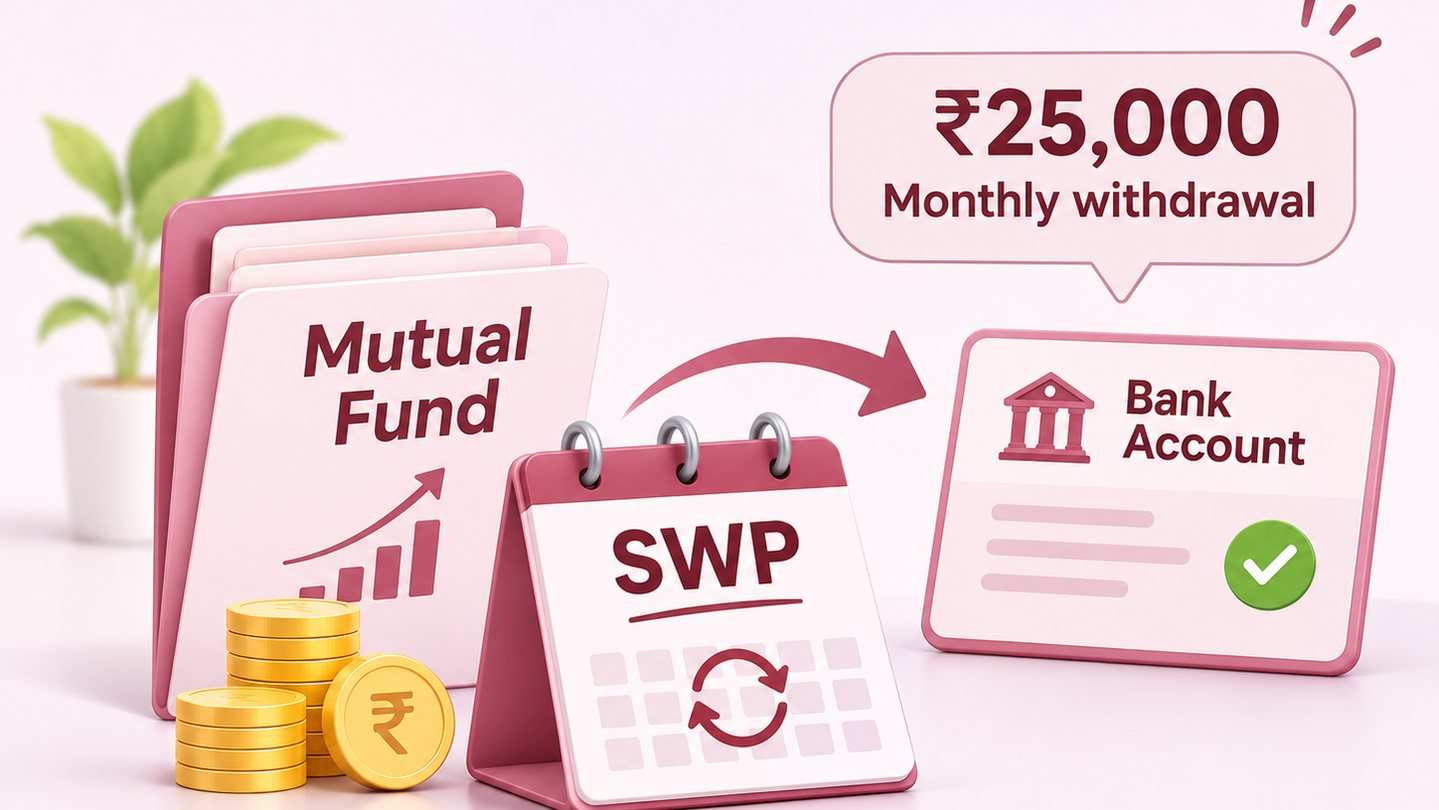
SWP turns a mutual fund corpus into monthly income. 2026 tax rules, a worked tax calculation, and how much corpus you need for ₹25,000 a month.
A Systematic Withdrawal Plan (SWP) pays you a fixed amount from a mutual fund every month while the rest stays invested. Salaried Indians use it to turn a retirement corpus — their own or their parents' — into monthly income. Kedil, a personal budgeting app for salaried Indians, helps you work out the monthly number an SWP has to cover.
SIP is how money goes in. SWP is how it comes out. The rest is mechanics, tax, and one risk nobody talks about.
How does an SWP work in mutual funds?
An SWP works by selling a small portion of your mutual fund units every month and crediting a fixed amount to your bank account. You choose the amount and the date. The remaining units stay invested and continue to earn market returns. No paperwork repeats — it runs until you change or stop it.
Example. Your father retires with ₹30 lakh from PF and gratuity. It goes into a mutual fund with an SWP of ₹20,000 a month — ₹2.4 lakh a year. If the fund earns around 8%, that's roughly ₹2.4 lakh on ₹30 lakh: the corpus holds its value while paying a monthly income. No pension needed.
Raise the withdrawal to ₹30,000 a month and the same corpus shrinks by over ₹1 lakh a year. The gap between what the fund earns and what you withdraw decides everything.
What is the difference between SIP and SWP?
SIP invests a fixed amount into a mutual fund every month to build a corpus during your earning years. SWP withdraws a fixed amount every month to create income from that corpus when the salary stops. Same fund, opposite direction.
| SIP | SWP | |
|---|---|---|
| Direction | Money goes in monthly | Money comes out monthly |
| Life stage | Earning years | Retirement / income years |
| What moves | You buy units | Fund sells your units |
Typical sequence: SIP from 30 to 55, then switch the same corpus to SWP.
How is SWP taxed in India? (with calculation)
Each SWP withdrawal is a redemption, but only the gains portion is taxed — your own capital coming back is tax-free. For equity funds in 2026: gains on units held over 12 months are taxed at 12.5%, and only above ₹1.25 lakh of gains per financial year. Units held 12 months or less: 20%. Debt fund gains are added to income and taxed at slab. No TDS for resident Indians.
Worked calculation. You run a ₹10,000 monthly SWP from an equity fund held over a year. Say ₹3,500 of each withdrawal is gain and ₹6,500 is your own capital returning. Annual gains: ₹42,000 — well under the ₹1.25 lakh exemption. Tax payable: zero.
The same ₹10,000 a month from an FD is interest income: ₹1.2 lakh added to your income, and at the 30% slab that's ₹36,000 in tax for identical monthly cash.
How much corpus do you need for ₹25,000 per month?
At an assumed 8% annual return, you need roughly ₹37.5 lakh to draw ₹25,000 a month without eating into the corpus. The rule: corpus = annual withdrawal ÷ expected return. Withdraw more than the fund earns, and the corpus starts depleting.
| Monthly income needed | Corpus needed (at ~8%) |
|---|---|
| ₹15,000 | ~₹22.5 lakh |
| ₹25,000 | ~₹37.5 lakh |
| ₹40,000 | ~₹60 lakh |
Illustration only — real returns vary year to year, and inflation pushes the "monthly income needed" number up over time.
Before this math works you need the left column: what the household actually spends per month. Most people guess, the guess is usually low, and an SWP sized on a wrong number runs out early.
Is SWP better than FD for monthly income?
For drawing income from a corpus, SWP is usually more tax-efficient than an FD: SWP withdrawals are taxed only on the gains portion — often fully inside the ₹1.25 lakh LTCG exemption — while FD interest is fully taxable at your slab rate. FDs win on certainty: the rate is locked, and the market can't touch it.
Practical split many households use: enough in FDs for 1–2 years of expenses (certainty), the rest in a mutual fund SWP (tax efficiency + growth).
When does an SWP make sense — and when not?
An SWP makes sense when you have a lump sum, no pension, and need monthly income — and when you want tax treated as capital gains rather than interest. It doesn't make sense when the withdrawal exceeds what the fund realistically earns, when the money sits in a volatile fund, or when you're still earning and don't need the income yet.
The risk nobody mentions: a market fall in the first years of retirement plus fixed withdrawals is how corpuses die early. An SWP guarantees withdrawals, not returns. The gap between those two is your risk — review the amount yearly.