
What is a good savings rate in India? Salaried benchmarks
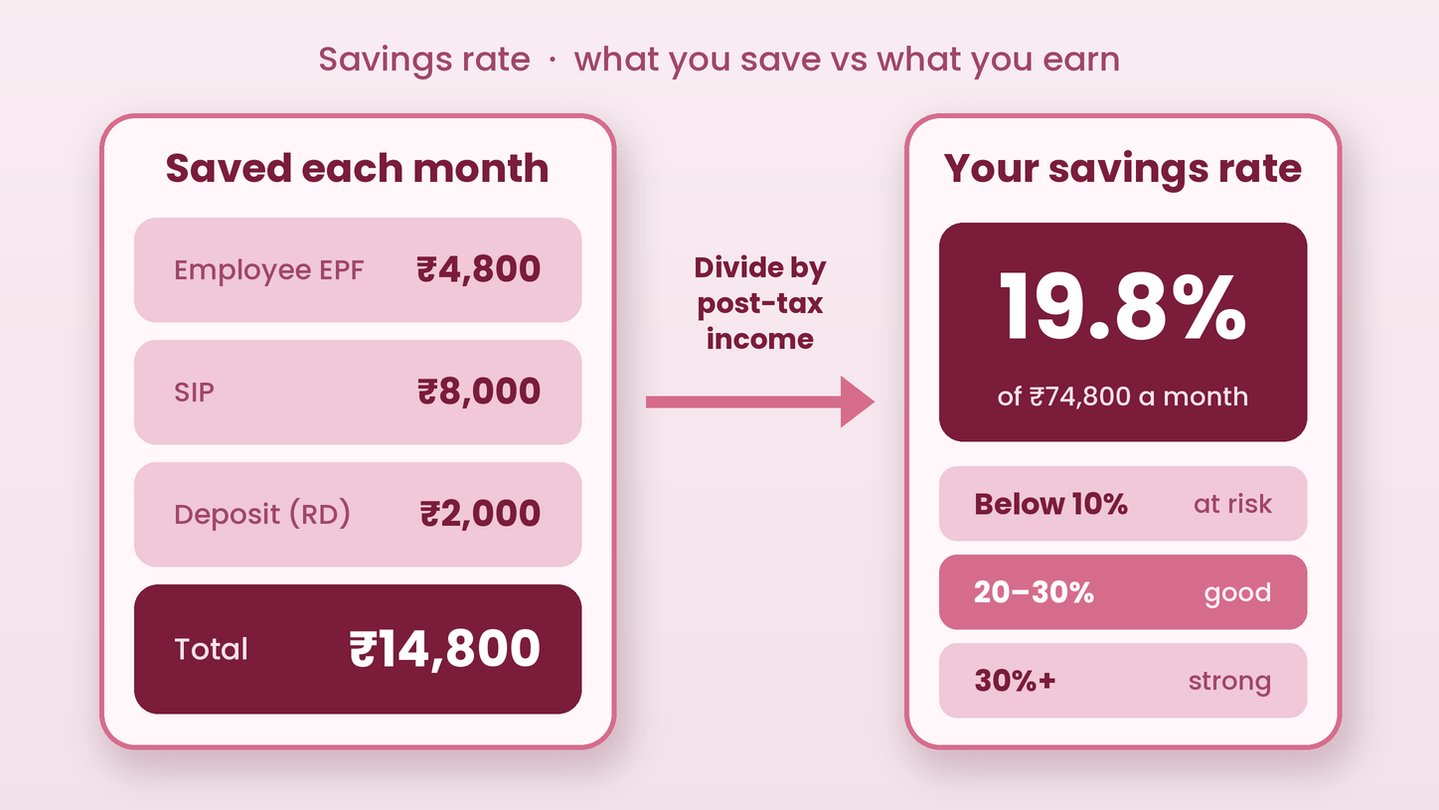
Most of us guess our savings rate, and the guess is usually wrong. Here's what a good savings rate in India looks like for a salaried household, how to measure yours with EPF and EMIs counted, and how to raise it without giving up everything.
A good savings rate in India is 20% of post-tax income at the floor, and 30% as the target for salaried households carrying EMIs. Count your EPF, SIPs and loan principal in it. Kedil, a budgeting app for salaried Indians, shows you the real number by importing your bank statement PDF and tracking every EMI in one place.
Most guides stop at the percentage, but a percentage only means something against a goal. Your savings rate decides when you can stop depending on a salary, which is the question behind Retirement planning in India. Get the rate wrong, or measure it the wrong way, and every later number in your plan is off with it.
I've spent 15+ years in financial infrastructure, mostly disaster recovery and business continuity, and I build Kedil. A savings rate is a recovery target: how much must you set aside, every month, so the household keeps running when income stops. This guide covers the good savings rate by salary and age, the savings rate formula, what counts as savings for a salaried Indian, why the 50/30/20 rule bends here, and how to raise your rate.
| Savings rate (of post-tax income) | What it usually means | Who it fits |
|---|---|---|
| Below 10% | One missed salary becomes a crisis | Early career, or a heavy EMI load |
| 10–20% | Slow progress, no real cushion | Where most households start |
| 20–30% | A good savings rate for most salaried people | Stable job, EMIs under control |
| 30–40% | Strong; retirement near 60 becomes realistic | Dual income, or EMIs ending soon |
| 40%+ | Early retirement is on the table | High income or low fixed costs |
Good savings rate in India: the benchmarks
Your savings rate is the share of your post-tax income that you save or invest instead of spending. The bands above are a working consensus, not a law. They move with your income, your age and how many EMIs you carry.
Savings rate bands for take-home pay
Two pages that rank for this question give the clearest bands:
- Lemonn sets 10–15% of take-home income as the minimum, 20–30% as good, 30–50% as excellent and 50–70% for early-retirement seekers
- Scripbox suggests at least 20% of take-home salary, rising to 30% if you start saving at 35 instead of 28
- Both treat take-home pay as the base, which is why I define it carefully later in this guide
Those numbers agree more than they disagree. A good savings rate in India sits between 20% and 30% for most salaried people, and the gap between the two ends depends on one thing: how late you start. The good savings rate for you is the one you can hold for years, not the one you can hold for a quarter.
What the national and survey data show
At the national level, the RBI's Annual Report for 2025-26 puts net household financial saving at 7.0% of gross national disposable income in 2024-25, up from 5.8% a year earlier. That figure is net of loans and leaves out gold and property, so it isn't your personal savings rate. It does show how thin the margin is once borrowing is taken out.
Even high earners miss the 20% mark. A Marcellus Investment Managers and Dun & Bradstreet survey of 465 respondents, all over 30 with post-tax household income above ₹20 lakh, found that 43% saved less than 20% of post-tax income and over half had loans, as reported by Business Standard in June 2025. Income doesn't fix a low savings rate. Habit does.
Why I treat 20% as a floor, not a goal
Twenty per cent is where the risk of a bad month falls and a long-term plan starts to work. It is not where the plan is finished. If you start at 25 with nothing saved, 20% takes about 45 years to reach financial independence on the assumptions I use later in this guide. At 30% it takes about 34.
So my view is simple. Use 20% as the minimum you never drop below, and 30% as the number you build toward in your 30s. If you can't hit 20% today, start at 10% and raise it with every salary hike.
How to calculate your savings rate
Learning how to calculate your savings rate starts with admitting that most people who say "I save about 10%" are guessing. The actual figure is almost always different, and usually higher, because the guess leaves out EPF.
The savings rate formula
Savings rate = (money saved and invested in the month ÷ post-tax income) × 100
That is the whole savings rate formula. Use it once a month, on the same day, with the same definitions, so the trend is comparable.
If you save ₹5,000 from a ₹25,000 salary, the rate is 20%. The savings rate formula is simple. The hard part is deciding what goes into the top and the bottom.
What counts as savings: EPF, SIPs and EMI principal
Count everything that turns income into an asset or reduces a debt:
- Your own EPF contribution, which is 12% of basic pay for most salaried employees
- SIPs, recurring deposits, PPF and NPS contributions
- Money moved to your emergency fund
- The principal part of loan EMIs, because it builds equity or clears debt
- Extra prepayments on loans
Leave out the interest part of an EMI. It is a cost, not a saving. Your employer's EPF share is a bonus; I leave it out of the headline rate to keep the number conservative.
Use post-tax income, not CTC
The bottom of the savings rate formula should be what you actually earned after tax, not the CTC on your offer letter. CTC includes employer contributions, gratuity and sometimes variable pay you may never see. Use it and your savings rate looks smaller than it is, because the income is inflated.
A clean definition for a salaried person: take-home salary plus your own EPF deduction. That is your post-tax income.
Worked example: ₹74,800 post-tax income
Here is the savings rate formula at work. Say your take-home salary is ₹70,000 and ₹4,800 goes to EPF each month. Your post-tax income is ₹74,800. You also run a ₹8,000 SIP and a ₹2,000 recurring deposit, and your home loan EMI has ₹5,000 of principal in it.
| Item | Monthly amount |
|---|---|
| Employee EPF | ₹4,800 |
| SIP | ₹8,000 |
| Recurring deposit | ₹2,000 |
| Savings without EMI principal | ₹14,800 (19.8%) |
| Home loan principal | ₹5,000 |
| Savings with EMI principal | ₹19,800 (26.5%) |
This person thinks they save ₹10,000, or 13%. Their real savings rate is between 20% and 26%, depending on whether they count loan principal. The number you'd have guessed and the number you'd have measured are far apart.
How much of your salary should you save?
The question "how much of your salary should you save" has no single answer, because the right savings rate depends on how much room your income leaves after needs. The table below shows what each band means in rupees, so you can see what a good savings rate costs at your pay level.
| Post-tax income a month | 10% | 20% | 30% | 40% |
|---|---|---|---|---|
| ₹30,000 | ₹3,000 | ₹6,000 | ₹9,000 | ₹12,000 |
| ₹50,000 | ₹5,000 | ₹10,000 | ₹15,000 | ₹20,000 |
| ₹75,000 | ₹7,500 | ₹15,000 | ₹22,500 | ₹30,000 |
| ₹1,00,000 | ₹10,000 | ₹20,000 | ₹30,000 | ₹40,000 |
| ₹1,50,000 | ₹15,000 | ₹30,000 | ₹45,000 | ₹60,000 |
How much of your salary should you save on ₹30,000 to ₹50,000?
On a modest salary, needs take most of the money. Akshay Gulati of Super Investing AI points out that someone earning ₹30,000 may spend ₹25,000 on essentials alone. At that level, 10% (₹3,000) is a realistic start, and he says saving 5–10% is still worthwhile when 20% isn't possible.
My advice here is not to wait for a better month. Set up the ₹3,000 SIP or recurring deposit on salary day and raise it later. The habit matters more than the amount at this stage.
How much of your salary should you save on ₹75,000 to ₹1 lakh?
This is where most of Kedil's audience sits: salaried, 30 to 40, with a home or vehicle loan and children's costs. A good savings rate here is 20–30%, which is ₹15,000 to ₹30,000 a month. EMIs are the swing factor. If your EMIs take 35% of income, 20% is your honest ceiling until a loan closes.
How much of your salary should you save on ₹1.5 lakh and above?
Higher income removes the excuse. Mohit Gang, quoted in the same Business Standard piece, suggests that anyone earning above ₹20 lakh a year should aim for at least 30–40% of post-tax income. A household on ₹1.5 lakh a month is close to that line. With room to spare, the question stops being "can I save 30%" and becomes "where does the 30% go".
Does the 50/30/20 rule work in India?
The 50/30/20 rule splits take-home salary into 50% needs, 30% wants and 20% savings. It was popularised by Elizabeth Warren, and it is the most common answer to "how much of my salary should I save". The 20% matches the floor I gave above, so on paper it works.
In practice the 50/30/20 rule needs adjusting for Indian households, and here is where it bends.
Where the 50/30/20 rule breaks for salaried Indians
India TV News quoted Gulati arguing that the rule suits economies with stronger social security. Here, metro rent, out-of-pocket healthcare and family support push needs past 50%. His example: on a ₹60,000 salary, ₹30,000 is the needs budget, but a ₹20,000–25,000 rent leaves only ₹5,000–10,000 for everything else essential.
There is a second problem. The rule doesn't say where EMIs go. A ₹18,000 home loan EMI is a need. A ₹2,500 phone EMI is a want. Mix them and the percentages stop meaning anything.
A 60/20/20 split for EMI-heavy households
If your needs run above 50% because of rent or a home loan, drop the 50/30/20 rule and move to 60/20/20: 60% needs including the main EMI, 20% wants, 20% savings. Keep the 20% fixed and squeeze wants instead.
When you have several EMIs, the next question is which one to close first. Our guide, I Have 5 EMIs. Which One Should I Close First?, covers that order. Every EMI you close moves money from the needs bucket to the savings bucket without touching your lifestyle.
Fix the priority order before the percentages
Gulati's alternative is a priority order, not another ratio:
- Essentials and an emergency fund
- Health and term insurance
- High-interest debt, such as credit card dues
- Long-term investing
- Discretionary spending from whatever remains
I agree with this. A 25% savings rate with no emergency fund and no health cover is a fragile 25%.
Build an emergency fund of three to six months of expenses before you push your savings rate higher. Without it, one hospital bill pulls the whole rate back to zero.
Good savings rate by age and goal
Age changes the arithmetic because time does the heavy lifting. A good savings rate by age is really a question of how many years of compounding you have left: the earlier you start, the lower the rate you need.
Savings rate by age: your 20s, 30s and 40s
- Savings rate by age 20s: fixed costs are lower, so aim above 20% if you can; the compounding is worth more than anything you buy now
- Savings rate by age 30s: the target is 30% as EMIs, school fees and parents' costs compete for the same salary
- Savings rate by age 40s: a rate below 30% leaves a short runway, and you are likely to need 35–40%
Scripbox puts the same idea in one line: starting at 28, 20% is enough; starting at 35, you need around 30%.
Good savings rate when you have a home loan
A home loan changes the maths in two ways. The EMI sits inside your needs, so your free income is smaller. But the principal part of every EMI is also saving, so your real savings rate is higher than the SIP alone suggests. A household with a long home loan can reasonably sit at 20–25% on the strict definition and 30% once principal is counted.
The risk is the opposite one: treating the home loan as your whole savings plan. Property is illiquid, and you can't sell a bedroom to cover a medical bill. Keep some savings in forms you can reach, and keep the emergency fund separate.
Years to financial independence at each savings rate
Here is the arithmetic. I assumed you start with nothing, your income and spending stay flat in inflation-adjusted rupees, your savings earn 4% above inflation (roughly a 10% return with 6% inflation), and financial independence means a corpus of 30 times your yearly spending, which is a 3.3% withdrawal rate.
| Savings rate | Years to financial independence |
|---|---|
| 10% | About 63 |
| 20% | About 45 |
| 30% | About 34 |
| 40% | About 26 |
| 50% | About 20 |
These are starting-from-zero figures. In real life you already have EPF, and raises you save instead of spend shorten the path. But the shape holds: the move from 20% to 30% saves around ten years, which is more than any fund choice will.
The corpus side of this is covered in the retirement guide linked earlier. The savings rate is the input; the corpus is the result.
The freefincal counterpoint
Some Indian planners argue for far higher rates. freefincal says a single person with no dependents should invest about as much as they spend for a normal retirement, and close to twice as much to retire early. That is a 50% rate or more.
It lines up with my table, where 50% gets you to independence in about 20 years. But most salaried households with children and a home loan can't run at 50%. I'd treat it as a ceiling worth knowing, and 30% as the working target.
Why salaried Indians miss their savings rate
The percentage isn't usually the problem. The measurement is.
Measuring against CTC instead of post-tax income
A ₹12 lakh CTC doesn't mean ₹1 lakh a month in your account. After EPF, tax and professional tax, the take-home may be far less. Run your savings rate against CTC and 20% of ₹1 lakh looks like a target you can't meet, because you never had the ₹1 lakh.
Forgetting irregular expenses and EMIs
Some costs arrive once or twice a year, so they don't show up in a monthly budget:
- Annual insurance premiums
- School and tuition fees
- Festival and wedding spending
- Vehicle servicing and insurance renewal
The savings you meant to make is quietly spent on them in the month they land. Divide each one by twelve and set it aside monthly, as a sinking fund.
EMIs create the opposite error. People include the full EMI in "expenses" and then wonder why their rate looks low. Split it into interest and principal and the picture changes.
Saving what's left
The most common reason a good savings rate fails is the order of operations. If you save whatever is left at month-end, there is usually nothing left. Spending expands to match the money available.
Reverse it, as the 50/30/20 rule intends: savings first. Move the savings out on salary day, before you can spend it, and live on what remains. EPF works because it never reaches your account. Copy that for your SIP.
Treating the emergency fund as optional
A savings rate built on SIPs alone is fragile. Without an emergency fund, one job loss or hospital bill forces you to stop the SIP or sell units at a bad time, and the rate drops to zero for months. Keep three to six months of essential expenses in a savings account or liquid fund before you raise the rate further. Count the monthly top-up to your emergency fund as savings until it is full, then redirect that money to investing.
How to raise your savings rate
You don't need to cut your life in half. Three habits move the rate over a year or two:
- Apply the hike rule to every raise
- Close costly EMIs early and redirect the freed money
- Check your savings rate monthly, not yearly
Use the hike rule
Gulati suggests directing about 40% of any salary raise to investments. On a ₹8,000 monthly raise, that is ₹3,200. Your lifestyle still improves, and your rate climbs every year without a painful cut. Apply it on the first month of the raise, before the new salary becomes normal.
On the ₹74,800 example, one ₹8,000 raise with 40% saved lifts the rate from 19.8% to 21.7%, and a second takes it to 23.3%. That is slow on its own, so pair it with closing an EMI. Each extra 5 points on that income is ₹3,740 a month, or ₹44,880 a year.
Close costly EMIs early
A loan EMI is a fixed claim on your income. Close it and the freed amount can go straight into savings. Put every EMI next to your income in the Budget Planner to see how much of each month they claim, then target the highest-interest loan first.
Track your savings rate monthly with Kedil
You can't raise a number you don't measure. Most people do this in a spreadsheet and abandon it by March, because entering every transaction by hand is work.
Kedil is built for that:
- The Bank Statement Analyzer reads your bank statement PDF, so you don't type anything or convert it to CSV
- All your loans and EMIs are tracked together in one place
- The Savings Goal Tracker tracks what you set aside against a target date
Kedil isn't an investment app. It shows you the two inputs that make your savings rate honest: what you spent and what your debts cost.
A monthly check takes about ten minutes. Compare your savings rate with last month, find the biggest category that grew, and decide the one change for next month.