
Retirement planning in India: 7 steps for salaried people
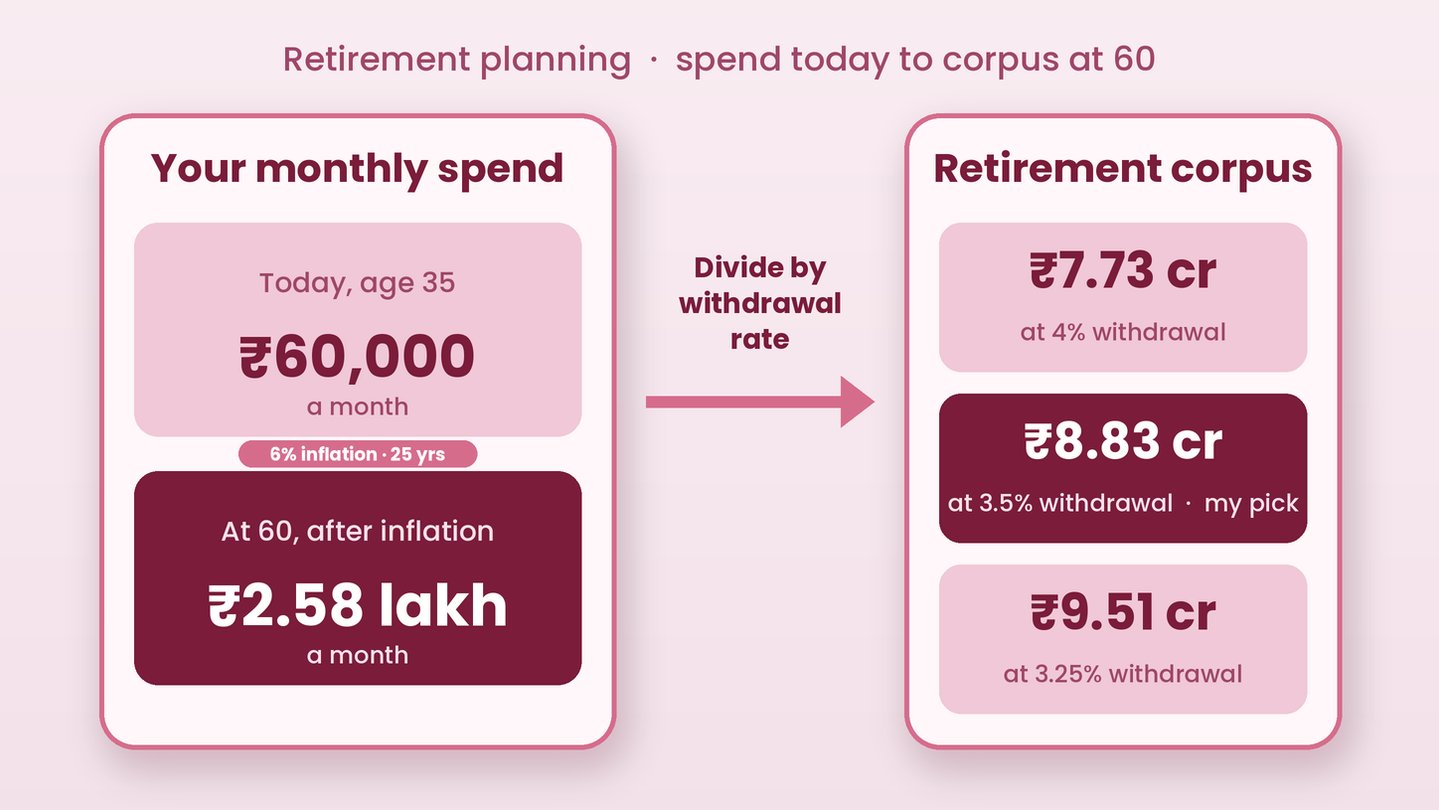
Retirement planning isn't about buying a pension plan. It's three numbers: your spend at 60, the corpus that funds it, and the monthly saving that gets you there. Here's how a salaried Indian works all three, with a ₹60,000-a-month example you can copy.
Retirement planning for a salaried Indian means three numbers: your spend at 60, the corpus that funds it, and the monthly saving that gets you there. Need the income side? Read How to invest in SWP. Kedil, a personal budgeting app for salaried Indians, imports bank statement PDFs and tracks every EMI, so your plan starts from real spend.
Most retirement advice starts with a product: buy this pension plan, open that fund. That's backwards. Private-sector jobs rarely come with a guaranteed pension, so retirement planning in India has to start with what you'll spend, and the rest is arithmetic. The arithmetic is getting harder too. Retail inflation was 6.09% in October 2026, up from 2.74% in January, according to MoSPI data reported by ThePrint.
I've spent 15+ years in financial infrastructure, mostly disaster recovery and business continuity, and I build Kedil. Retirement planning for salaried employees is the same job: work out what must keep running, for how long, and what it costs. This guide covers the retirement corpus formula, the retirement planning steps in order, EPF, NPS and PPF rules for 2026, and a worked ₹ example.
| Instrument | Role in your retirement plan | 2026 detail |
|---|---|---|
| EPF | The base most salaried people already have | 8.25% for FY2025-26 |
| NPS | Tax-efficient top-up, market-linked | Up to 80% lump sum at exit under the NPS withdrawal rules, for non-government subscribers above ₹12 lakh |
| PPF | Safe, fixed-return layer | 7.1% for Oct to Dec 2026, reviewed every quarter |
| Equity mutual fund SIP | Growth that can beat inflation | Not guaranteed; needs 10+ years |
| Annuity or SWP | Turns the corpus into monthly income | NPS needs at least 20% in an annuity above ₹12 lakh |
What retirement planning means for a salaried Indian
Retirement planning in India is deciding, years ahead, how you'll pay for life after your salary stops. The usual retirement age is 60. The money has to last a lot longer than most people assume.
Why retirement planning in India falls on you
- Most private-sector employees have no government-backed pension, so your own savings are the pension
- A 60-year-old today could easily live another 25 to 30 years, according to Business Today
- Food inflation hit 8.94% in October 2026, and food is the part of the basket retirees can't cut
At 6% a year, prices double roughly every 12 years. If you're 35 and spend ₹60,000 a month today, the same lifestyle costs about ₹2.58 lakh a month at 60. That gap is why you plan early.
Retirement planning for salaried employees: what's different
Your income is regular and visible, which helps. EPF comes out of your salary before you can spend it, and that's the best thing about being salaried. But your household also carries EMIs, school fees and often your parents' medical costs. Retirement planning for salaried employees has to fit around all of that, not sit on top of it.
A retirement plan is not one product
A pension plan, an NPS account and a mutual fund are tools. The plan itself is three things: a target number, a date, and a monthly amount. If you can't write all three on one line, you don't have a plan yet.
How much retirement corpus do you need?
Your retirement corpus is the lump sum that has to fund your spending for the rest of your life. You can estimate it in three moves.
The retirement corpus formula
- Take today's monthly spend, leaving out EMIs that will be paid off before you retire
- Grow it by inflation for the years left: spend × (1 + inflation) ^ years
- Divide the yearly figure by a withdrawal rate, which is the share of the corpus you take out in year one
After year one, you raise the withdrawal by inflation each year. The lower the withdrawal rate, the bigger the corpus and the safer the plan.
Worked example: how much money do I need to retire at 60?
Say you're 35, plan to retire at 60, spend ₹60,000 a month, and assume 6% inflation.
| Step | Number |
|---|---|
| Spend today | ₹60,000 a month |
| Spend at 60, after 25 years of 6% inflation | About ₹2.58 lakh a month, ₹30.9 lakh a year |
| Retirement corpus at a 4% withdrawal rate | About ₹7.73 crore |
| Retirement corpus at a 3.5% withdrawal rate | About ₹8.83 crore |
| Retirement corpus at a 3.25% withdrawal rate | About ₹9.51 crore |
How much money do I need to retire has no single answer. It has a range, and it moves with your spend and the withdrawal rate you pick.
Why a 3.5% withdrawal rate fits India better than 4%
The 4% rule was designed for the US market, and Indian planners argue it doesn't fit our conditions. Financial planner Niraj Dugar worked this through for Business Today in September 2026: ₹15 lakh a year needs ₹3.75 crore at 4% but ₹4.62 crore at 3.25%.
I plan with 3.5% and test it. Take the ₹8.83 crore corpus above, withdraw ₹30.9 lakh in year one and raise it 6% a year. If the rest earns 8% a year, it lasts about 41 years. At 7% it lasts about 34 years, so you'd run out near 94. These are my assumptions, not forecasts, and they're why I wouldn't go above a 3.5% withdrawal rate.
Retirement age: what 50, 55 and 60 do to the retirement corpus
Retiring earlier means fewer years to save and more years to fund. I lower the withdrawal rate as the retirement age drops, because the money has to last longer. Same example, same ₹60,000 a month, SIP at an assumed 10% a year:
| Retirement age | Withdrawal rate I'd use | Retirement corpus | Monthly SIP needed |
|---|---|---|---|
| 50 | 3% | About ₹5.75 crore | About ₹1.25 lakh |
| 55 | 3.25% | About ₹7.11 crore | About ₹81,300 |
| 60 | 3.5% | About ₹8.83 crore | About ₹55,700 |
Retiring at 50 needs a smaller corpus, but you only get 15 years to build it. For most salaried households, a retirement age of 60 is the realistic one, with 55 as a stretch.
Retirement planning steps for salaried employees
Here are the seven retirement planning steps in order. They work whether you're 30 or 45; only the numbers change. Don't skip ahead to step 4, because the first three decide how big everything else has to be. Work through the retirement planning steps once on paper, then revisit them every year.
Retirement planning steps 1 to 3: know your numbers
- Find your real monthly spend. Use three months of bank statements, not memory. People guess low by a surprising margin, and a low guess becomes a short retirement.
- Plan to clear your EMIs before 60. A home loan EMI running into retirement means your corpus is paying a bank. If you have several loans, Which loan to pay off first helps you pick the one costing you most.
- Set the corpus target and your retirement age. Use the formula above, choose a withdrawal rate, and write the number down.
Retirement planning steps 4 and 5: pick where the money goes
- Use EPF as the base, then add the rest. Add NPS if your employer offers it (read the NPS withdrawal rules first), PPF for the safe layer, and an equity SIP for growth.
- Automate it and step it up. A flat SIP is the expensive way to do retirement planning for salaried families. Raise it every year when your salary rises.
Here's what the example needs. Your EPF (₹8 lakh today plus ₹8,000 a month at 8.25%) grows to about ₹1.37 crore by 60. That leaves a gap of about ₹7.46 crore against the 3.5% target. Assume an equity SIP earns 10% a year, which is an assumption and not a promise:
| Lever | Monthly SIP needed |
|---|---|
| Flat SIP for 25 years, no changes | About ₹55,700 |
| Retire at 62 instead of 60 | About ₹49,900 |
| Spend ₹45,000 a month today instead of ₹60,000 | About ₹39,200 |
| SIP that rises 10% every year | About ₹22,700 to start |
The step-up is the lever most salaried people can actually pull. Your salary rises, so your SIP should too. Retiring later helps less than you'd expect, because your inflated spending is bigger by then too.
Retirement planning steps 6 and 7: protect and review
- Cover health risk first. Keep a health insurance policy and six months of expenses as an emergency fund. A hospital bill shouldn't come out of your retirement corpus.
- Review once a year. Check your spend, your SIP, your EMIs and your target. These retirement planning steps repeat every year, so a retirement plan is a habit, not a one-time task.
Retirement planning mistakes salaried employees make
- Withdrawing EPF every time they change jobs, which resets the tax-free clock and stops the compounding
- Planning with today's prices and forgetting inflation
- Stopping the SIP while EMIs run and never restarting it
- Putting everything in one product, whether that's PPF, NPS or a single fund
- Counting a house they live in as retirement income
- Never writing the plan down, so there's nothing to review
Where to invest for retirement planning: EPF, NPS, PPF and mutual funds
Retirement planning in India works best with several instruments, because each does a different job and fails in a different way. Use them together instead of picking one.
EPF: the base layer of retirement planning for salaried people
- You contribute 12% of basic pay plus DA, and your employer adds a matching contribution, part of which goes to the pension scheme
- The rate was 8.25% for FY2025-26, the third year in a row at that level
- Withdrawals after five years of continuous service are tax-free
When you change jobs, transfer the EPF instead of withdrawing it. Withdrawing before five years of continuous service makes the money taxable, and it stops compounding either way.
NPS for retirement planning: tax benefits and NPS withdrawal rules
NPS is market-linked and voluntary. Its tax benefit depends on your regime:
- Employer contributions are deductible in both regimes: up to 14% of basic plus DA under the new regime, and 10% for private-sector employees under the old one. Ask HR if your company offers corporate NPS
- Your own extra ₹50,000 under Section 80CCD(1B) is available only in the old regime
The NPS withdrawal rules changed in December 2025. For non-government subscribers, these now apply:
- Corpus above ₹12 lakh: up to 80% as a lump sum, at least 20% into an annuity
- Corpus of ₹8 to ₹12 lakh: up to ₹6 lakh as a lump sum, and the balance as systematic unit redemption for at least six years, or an annuity
- Corpus up to ₹8 lakh: the whole amount can be taken out
- Government employees still follow the 60/40 split
- Partial withdrawals before retirement are allowed only for specified purposes such as education, marriage, a home purchase, medical treatment or a business
The headline "80% lump sum" is one of the NPS withdrawal rules. Whether all of it is tax-free is a separate matter under the Income-tax Act, so check the current exempt share before you plan around it.
Before the December 2025 amendment, non-government subscribers had to put 40% of the corpus into an annuity. The new NPS withdrawal rules cut that to 20%. That gives you more control, and more responsibility for making the money last.
PPF and equity mutual funds in a retirement plan
PPF pays 7.1% for October to December 2026. The government reviews the rate every quarter and has left it unchanged for more than two years. It has a 15-year tenure, which suits the safe layer of your plan.
An equity SIP is where growth comes from. Over 20 to 25 years, equity has the best chance of beating inflation. It can also fall 30% the year before you need the money, which is why the last five years before retiring need a different plan.
Retirement planning by age: your 30s, 40s and 50s
Time is the biggest input to retirement planning in India. This table shows what it costs to wait: the monthly SIP needed to reach ₹5 crore by 60, assuming 10% a year.
| Start age | Years to 60 | Monthly SIP needed |
|---|---|---|
| 25 | 35 | About ₹13,100 |
| 30 | 30 | About ₹21,900 |
| 35 | 25 | About ₹37,400 |
| 40 | 20 | About ₹65,300 |
| 45 | 15 | About ₹1,19,600 |
Retirement planning in your 30s: let time do the work
- Start with whatever you can, then raise it every year. A 10% step-up is far easier now than catching up in your 40s
- Take the employer NPS match if one exists
- Don't let a home loan stop your EPF and SIP completely. Shrink the SIP, not to zero
Retirement planning in your 40s: the crowded decade
Your EMIs, children's education and parents' medical costs all peak together. This is when most people pause retirement saving, and it's the most expensive moment to pause.
- Protect the SIP before you fund any lifestyle upgrade
- Compare prepaying the home loan with investing the same money
- Review insurance cover, since your dependents rely on it most now
- Transfer your EPF at every job change instead of withdrawing it
Retirement planning in your 50s: protect what you've built
- Start moving money from equity into safer funds, in steps, about five years before your retirement age
- Clear the last EMIs
- Write down the withdrawal plan before you retire, not after
Retirement planning for salaried couples: plan one number, not two
If both of you earn, work out one household target first, then split the saving. Two half-plans usually leave a gap that neither of you can see.
- Add up both EPF balances and any NPS, then compare the total with one household retirement corpus
- Plan for the longer life. One of you may need income into your 90s
- Keep health cover for both of you, and check what happens if one salary stops early
How to turn your retirement corpus into monthly income
Retirement planning in India often stops at the corpus number, which is why this part gets skipped. Building the corpus is half the job. Drawing it down without running out is the other half.
The three-bucket approach to retirement income
- Bucket 1: two to three years of spending in a savings account or liquid fund
- Bucket 2: the next four to seven years in short-duration debt or conservative hybrid funds
- Bucket 3: the rest in equity, left alone to grow
Refill bucket 1 from the others once a year. A crash then costs you paper losses in bucket 3 and nothing in your monthly cash.
NPS annuity or SWP: how retirement income arrives
An annuity gives a fixed payout, and the payout is taxable. A systematic withdrawal plan (SWP) sells units from a mutual fund on a set date every month and keeps the rest invested. I'd use the annuity for the base spend you can't skip, like rent, groceries and medicines, and an SWP for the rest. Many people mix both.
The NPS withdrawal rules now let you keep more of the corpus outside an annuity, which helps if you want the SWP route. The catch is that you carry more of the risk yourself.
Check that your retirement corpus will last
Run this test every year after you retire:
- Is this year's withdrawal still around 3.5% of the corpus, after raising it for inflation?
- Did the corpus fall more than 20% in a year? If so, cut the withdrawal until it recovers
- Are the next two years of spending sitting in bucket 1?
How Kedil helps with retirement planning
Kedil doesn't pick funds for you. It does the part that comes before: it shows what you actually spend and owe, so the retirement plan starts from a true number. That's the gap in most retirement planning for salaried households: the plan assumes a spend nobody has measured.
See the real spend your retirement planning starts from
Step 1 needs three months of real spending. Upload your bank statement PDFs to the bank statement analyzer and Kedil sorts them by category, with no CSV conversion. You get a true monthly spend to feed into the retirement corpus formula, instead of a guess.
Clear EMIs before your retirement age
Kedil tracks every home, car and personal loan EMI in one place, so you can see how many years each one has left. Before you prepay anything, run the numbers on the prepay vs invest calculator. A home loan at 8.5% with tax benefits is a different decision from a personal loan at 14%.
Put a date on the retirement corpus goal
Set it up in the savings goal tracker: retirement corpus, target date and the monthly SIP. When the goal has a date and a monthly number, you notice the month it slips.
FAQ: retirement planning in India
How much money do I need to retire in India?
Roughly 25 to 30 times your yearly spending at retirement, adjusted for inflation. For ₹60,000 a month today at age 35, that's about ₹8.8 crore at 60.
At what age should I start retirement planning?
As early as your first salary. Starting at 25 instead of 35 cuts the SIP for a ₹5 crore goal from about ₹37,400 to ₹13,100 a month, at an assumed 10% return.
Is EPF enough for retirement planning in India?
EPF is a strong base, earning 8.25% in FY2025-26, but it's rarely the whole plan. Most salaried people need NPS, PPF or equity SIPs on top.
What are the new NPS withdrawal rules?
Non-government subscribers with a corpus above ₹12 lakh can take up to 80% as a lump sum and must annuitise at least 20%. Check tax treatment separately.
Can I do retirement planning for salaried families with a home loan?
Yes. Follow the same retirement planning steps: keep EPF and a smaller SIP going, compare prepayment with investing, and aim to clear EMIs before retirement so your corpus isn't paying a bank.
Is NPS or a mutual fund SIP better for retirement planning?
NPS adds tax benefits and discipline, but NPS withdrawal rules limit access. SIPs are more liquid. Many salaried people use both, matched to their tax regime and goal.
Retirement planning for salaried families starts with knowing your real spend and EMIs. Kedil Planner helps you turn a retirement goal into a date and a monthly number. This guide is general education, not personalised investment advice.