
SIP withdrawal: how to take money out without losing it to tax
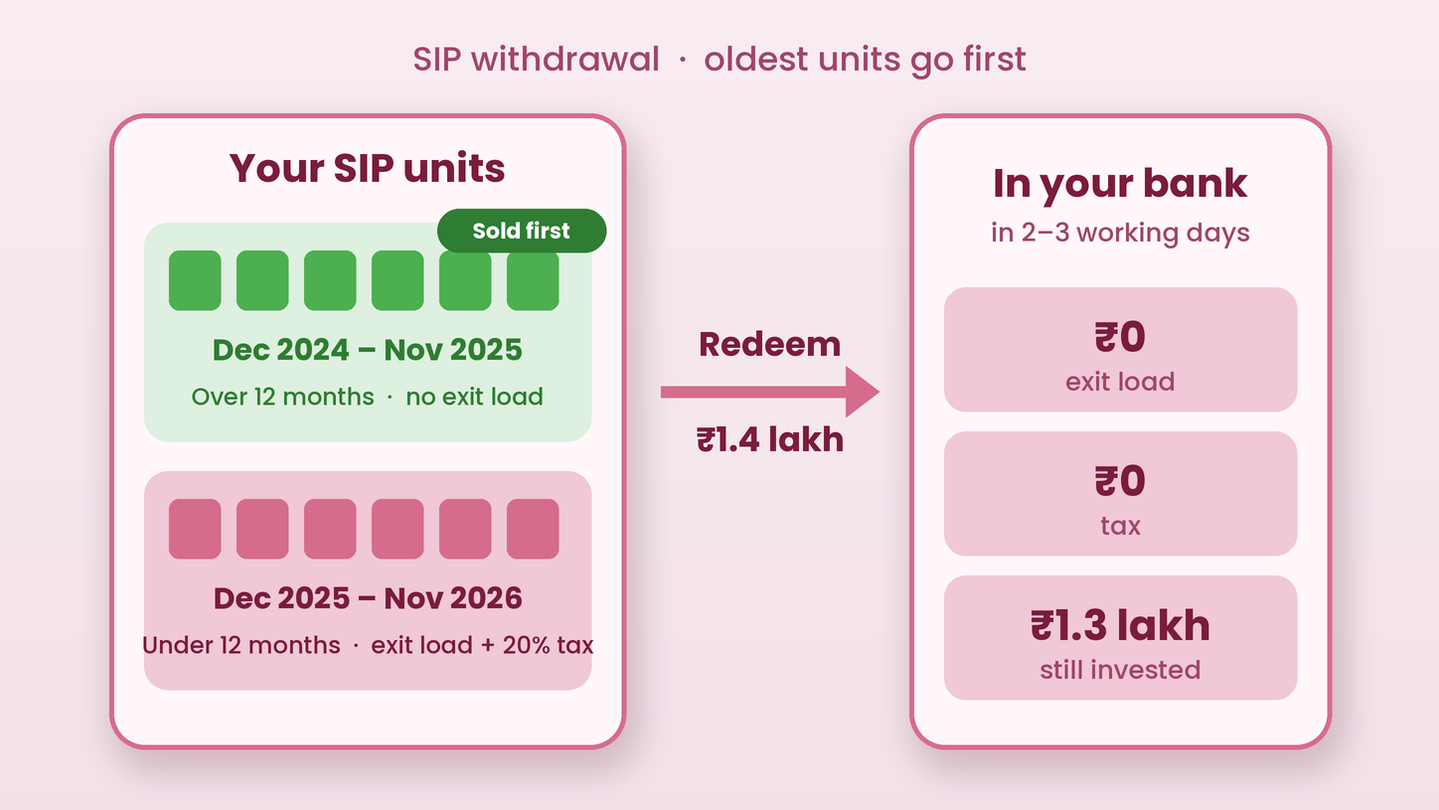
Withdrawing from a SIP isn't one action. It's selling units bought on different dates, each with its own exit load and tax clock. Here's how to withdraw SIP amount, how long it takes, and how to take ₹1.4 lakh out with no tax and no exit load.
A SIP withdrawal means redeeming some or all of the mutual fund units your SIP has bought, at that day's NAV, with the money landing in your bank within about three working days. Stopping the SIP doesn't withdraw anything, and withdrawing doesn't stop the SIP. Need steady monthly cash instead of one lump? Read How to invest in SWP. Kedil, a personal budgeting app for salaried Indians, tracks every EMI so you know exactly what you need.
Most people only think about SIP withdrawal when something goes wrong: a hospital bill, a school admission fee, a down payment that came up faster than planned. That's the worst time to learn the rules, because the order in which units are sold decides how much exit load and tax you pay.
I've spent 15+ years in financial infrastructure and I build Kedil, so I care about the plumbing: which units leave first, which clock each one is on, and how many days the money takes. This guide covers how to withdraw SIP amount online and offline, SIP redemption timelines, exit load, tax on SIP withdrawal with a worked ₹ example, and when a partial withdrawal beats cashing out everything.
| Question | Short answer |
|---|---|
| Can I withdraw anytime? | Yes, from open-ended funds. ELSS units are locked for 3 years each |
| Which units go first? | The oldest, first-in, first-out |
| How fast is the money? | Within 3 working days; liquid funds can be instant up to ₹50,000 |
| Exit load? | Only on units still inside the scheme's exit-load window |
| Tax? | Only on the gain, by each unit's holding period |
| Does it stop my SIP? | No. Cancel the SIP separately if you want to stop it |
What SIP withdrawal actually means
A SIP is just a way of buying. Every month, your bank pays the fund and you get units at that day's NAV. After 24 months you don't hold "a SIP". You hold 24 separate purchases of units, each with its own date and price. A SIP withdrawal sells some of those units.
SIP withdrawal vs stop SIP
These are two different actions, and mixing them up is the most common mistake I see.
- Stop SIP: cancels future debits. Every unit you already own stays invested
- SIP withdrawal: sells existing units. Your SIP keeps debiting next month unless you cancel it
- Pause SIP: many fund houses let you skip a few months without cancelling
If you need ₹1 lakh for a medical bill and still earn a salary, you usually want a partial withdrawal and to keep the SIP running. If you've lost your job, you may want to stop SIP debits too, so they don't bounce. A bounced SIP debit can attract bank charges.
Full or partial withdrawal from SIP
You can redeem everything, a rupee amount, or a number of units. A partial withdrawal is almost always the better first move. Take only what the expense needs, and leave the rest to keep compounding. With a rupee-amount request, the fund works out how many units to sell at that day's NAV.
Why SIP withdrawal isn't like an FD withdrawal
An FD pays back a fixed number. A SIP withdrawal pays whatever your units are worth that day. If you invested ₹2 lakh and the market is down 15% the week you need cash, a full SIP redemption returns about ₹1.7 lakh. That loss was on paper before; now it's real.
That's the case for keeping emergency money outside equity SIPs. Your equity SIP is for goals five or more years away. If you can't afford to withdraw money from SIP during a bad month, it shouldn't be in an equity SIP.
How to withdraw SIP amount: step by step
You withdraw money from SIP through the same route you invested. Here's how to withdraw SIP amount on each route.
How to withdraw SIP amount online
- Log in to the app or site you invested through: the AMC's own app, MF Central, or your broker or investment app
- Open the fund and tap Redeem or Withdraw
- Choose all units, a number of units, or a rupee amount
- Check the bank account the money will go to
- Confirm with OTP
Submit before the 3 pm cut-off and, for most equity, debt and hybrid funds, you get that day's NAV. After the cut-off, it's the next business day's NAV.
How to withdraw SIP amount offline
If you or your parents invested through a branch, fill the AMC's redemption slip with the folio number, scheme, and amount or units. Sign it as per the folio and submit it at the AMC or registrar office. Money still goes only to the bank account registered on the folio.
How to withdraw SIP amount held in a demat account
If your SIP units sit in a demat account through a stockbroker, you redeem from the broker's mutual fund section, not the AMC app. The steps are the same: pick the fund, enter units or amount, confirm. Money still goes to the bank account linked to that demat account. Some brokers add a small depository charge per redemption, so check before you split one SIP withdrawal into many small ones.
Not sure which route you used? Your consolidated account statement from CAMS or KFintech lists every folio. That's the quickest way to work out how to withdraw SIP amount from each one.
Stop SIP separately if you need to
Redeeming units doesn't cancel the SIP mandate. If you want debits to end, raise a cancellation in the same app or with the AMC a few working days before the next debit date. Otherwise next month's instalment goes in as usual.
How long SIP redemption takes
SEBI requires fund houses to transfer redemption money within three working days of the redemption date. Equity funds moved to a T+2 payout cycle in February 2023.
SIP redemption timelines by fund type
| Fund type | Typical credit after a valid request |
|---|---|
| Liquid and overnight funds | T+1 working day |
| Debt funds | T+1 to T+2 working days |
| Equity and hybrid funds | T+2 to T+3 working days |
| International funds and fund of funds | Up to T+5 working days |
T is the day your request counts, which depends on the cut-off time. A Friday-evening SIP redemption from an equity fund usually reaches you by Wednesday. Weekends and bank holidays don't count.
Instant SIP withdrawal from liquid funds
If your emergency money sits in a liquid fund, some schemes offer instant redemption. The cap is ₹50,000 or 90% of your holding, whichever is lower, per scheme per day. Above that, the normal T+1 cycle applies. Not every liquid fund offers it, so check before you rely on it.
This is why I keep one to two months of expenses in a savings account and the rest of the emergency fund in a liquid fund. You can't do an instant SIP withdrawal from an equity fund.
How much a SIP redemption actually pays
What reaches your bank is units sold × NAV on the redemption date, minus any exit load. If you redeem 400 units at a NAV of ₹125, that's ₹50,000. If 100 of those units are still inside a 1% exit-load window, ₹125 comes off, and ₹49,875 lands. No TDS is cut for resident investors; tax on SIP withdrawal is settled when you file your ITR.
What delays SIP redemption
- Requests after the cut-off time
- Bank holidays and weekends
- Bank account or KYC details that don't match the folio
- ELSS units still in lock-in (the request is rejected, not delayed)
Exit load and lock-in on SIP withdrawal
This is where SIP withdrawal gets tricky. Your SIP is many purchases, not one, so every instalment runs on its own clock.
Every SIP redemption checks each instalment's clock
Say your equity fund charges an exit load on units redeemed within 12 months, as many do. If you started the SIP in January and redeem everything in December, every instalment from January to November is still inside its window. Each one pays exit load.
Units are redeemed first-in, first-out. A partial withdrawal sells your oldest units first, and they're the ones most likely to be past the exit-load window.
- Units older than the window: no exit load
- Units inside the window: exit load on the amount redeemed
- Exit load is deducted from what you receive, not charged separately
ELSS lock-in on SIP withdrawal
ELSS units are locked for three years from each instalment's date. If you ran a 36-month ELSS SIP, only the first instalment is free at the three-year mark. The rest unlock one month at a time. No exit load applies once a unit is out of lock-in.
So don't plan an emergency SIP withdrawal from ELSS. That money isn't available.
A quick example. You ran a ₹5,000 ELSS SIP from April 2023 to March 2026 for 80C. In November 2026 only the instalments from April 2023 to November 2023 are free, about ₹40,000 at cost. The other 28 instalments unlock one by one through March 2029. Plan around those dates, not the SIP's start date.
How to check before you withdraw money from SIP
Open the fund's page in your app or on the AMC site and read the exit-load line. Then open your transaction statement and see which instalments are older than that window. Two minutes of checking can save you a few thousand rupees.
Tax on SIP withdrawal in 2026
You don't pay tax on the whole SIP withdrawal. You pay tax only on the gain, and each instalment's gain is judged by how long that instalment was held.
Tax on SIP withdrawal from equity funds
For equity funds, and hybrid funds with 65% or more in equity:
- Units held 12 months or less: short-term gain, taxed at 20%
- Units held more than 12 months: long-term gain, taxed at 12.5%
- The first ₹1.25 lakh of long-term equity gains each financial year is tax-free
One SIP withdrawal can include both kinds of gain, because FIFO sells old and new units together.
Tax on SIP withdrawal from debt funds
For debt fund units bought on or after 1 April 2023, gains are added to your income and taxed at your slab, however long you've held them. There's no long-term benefit and no ₹1.25 lakh exemption.
Older debt units bought before 1 April 2023 still get long-term treatment: held over 24 months, the gain is taxed at 12.5% without indexation. If your debt SIP started before then, a single SIP withdrawal can mix both rules, because FIFO sells the pre-2023 units first. Your capital gains statement from the registrar splits this out for your ITR.
Worked example: tax on SIP withdrawal of ₹1.4 lakh vs everything
Say you started a ₹10,000 monthly SIP in an equity flexi-cap fund on 1 December 2024. By 19 November 2026 you've put in ₹2.4 lakh over 24 instalments. Assume the NAV grew about 12% a year, so it's worth about ₹2.7 lakh. The fund charges 1% exit load within 12 months. You need cash for a home down payment.
The first 12 instalments, December 2024 to November 2025, are now over 12 months old. They're worth about ₹1.42 lakh.
| Withdraw ₹1.4 lakh | Withdraw everything (₹2.7 lakh) | |
|---|---|---|
| From long-term units | ₹1.4 lakh | ₹1.42 lakh |
| From short-term units | ₹0 | ₹1.27 lakh |
| Exit load | ₹0 | About ₹1,270 |
| Gain | About ₹22,000, all long-term | About ₹22,400 long-term + ₹7,200 short-term |
| Tax | ₹0, inside the ₹1.25 lakh exemption | About ₹1,440 STCG + cess |
| Left invested | About ₹1.3 lakh | ₹0 |
The full SIP withdrawal costs you about ₹2,700 in exit load and tax for nothing, and pulls ₹1.3 lakh out of the market that you didn't need. If the down payment needs more, wait until December: the next instalment crosses 12 months then.
How to cut tax on SIP withdrawal legally
- Wait for instalments to cross 12 months before a big SIP redemption from an equity fund
- Use the ₹1.25 lakh long-term exemption every financial year. A withdrawal split across late March and early April uses two years' exemptions
- Redeem a rupee amount, not "all units", so FIFO only touches your oldest units
- Keep tax on SIP withdrawal in mind when you switch funds. A switch is a redemption too, and it's taxed the same way
When to withdraw money from SIP, and when not to
A SIP withdrawal is a tool. The question is whether this is the right time and the right amount.
Good reasons to withdraw money from SIP
- The goal the SIP was for has arrived: a down payment, a child's admission, a wedding
- A real emergency, and your emergency fund is used up
- You're 1–3 years from the goal and want to move money into a safer debt or liquid fund, in steps
- Your fund has underperformed its category for years and you're switching
For goal-linked money, I'd start moving it out 12–24 months early through partial withdrawals. Then a crash in the final year can't wreck the plan.
How to withdraw money from SIP for a goal: start early
The cleanest way to withdraw money from SIP for a known goal is in stages, starting a year or two before the date. Say your daughter's college fee of ₹6 lakh is due in June 2028 and the money sits in an equity SIP.
| When | What you do | Why |
|---|---|---|
| December 2026 | Stop SIP in equity, start a SIP into a short-duration debt fund | New money no longer rides the market |
| December 2026 to March 2027 | Partial withdrawal of about ₹1.5 lakh from equity into debt | Uses this year's ₹1.25 lakh exemption |
| April 2027 to March 2028 | Partial withdrawal of the rest into debt | Uses next year's exemption |
| May 2028 | Final SIP redemption from the debt fund to your bank | Paid in time, no crash risk |
A crash in early 2028 then hits only a small slice of the money, not all of it.
Bad reasons for a SIP withdrawal
- The market fell 10% and you're scared. That's when your SIP buys units cheap
- A sale, a phone upgrade, a holiday you didn't plan for
- To prepay a loan without checking the maths
On that last one, a home loan at 8.5% with tax benefits is a different decision from a personal loan at 14%. Run the numbers on the prepay vs invest calculator before a SIP withdrawal goes to the bank. If you have several loans, Which loan to pay off first helps you pick the one that's costing you most.
Partial withdrawal vs stop SIP vs SWP
- Need a lump sum once: do a partial withdrawal and keep the SIP running
- Money is tight for a few months: pause or stop the SIP and don't touch the units
- Need monthly cash for years: set up an SWP on the same units instead of redeeming everything
If you stop SIP debits, restart them as soon as the pinch passes. Most people mean to and don't. A stop SIP for three months is fine; one that quietly turns into three years costs far more than the SIP withdrawal you avoided. Set a reminder the day you stop it. When you're unsure how to withdraw SIP amount without breaking a goal, take the smallest partial withdrawal that covers the bill, and come back to the rest next month.
How Kedil helps before a SIP withdrawal
Most SIP withdrawals happen because the monthly maths broke somewhere: too many EMIs, an expense nobody planned. Kedil helps you see that gap before you have to cash out.
See the gap before you withdraw money from SIP
The budget planner shows your income, every EMI and your spending in one place, built from your bank statement PDFs with no CSV conversion. If the month only works with a SIP withdrawal, you'll know weeks earlier. You can cut, pause the SIP, or plan a partial withdrawal from the right units.
Plan each SIP withdrawal with a goal and a date
Link each SIP to a goal in the savings goal tracker: emergency fund, down payment, school fees. When you know the date, you can plan the SIP withdrawal from units that are past exit load and into the lower tax bracket. Then it isn't a panic redemption.
FAQ: SIP withdrawal
Can I withdraw money from SIP anytime?
Yes, from open-ended funds. ELSS units are locked for 3 years per instalment. Units inside the exit-load window may attract an exit load.
Does SIP withdrawal stop my SIP?
No. Redeeming units doesn't cancel the mandate. Raise a stop SIP request separately, a few working days before the next debit date.
How long does SIP redemption take?
Within 3 working days by SEBI rules. Liquid funds pay in about T+1, and instant redemption gives up to ₹50,000 or 90% of the holding, whichever is lower.
How is tax on SIP withdrawal calculated?
Only the gain is taxed, unit by unit, FIFO. Equity: 20% if held 12 months or less, 12.5% above ₹1.25 lakh a year if longer. Debt: your slab.
Can I make a partial withdrawal from my SIP?
Yes. Redeem a rupee amount or number of units. A partial withdrawal sells your oldest units first, which usually means lower exit load and tax.
How to withdraw SIP amount if I invested offline?
Submit a signed redemption slip with your folio number at the AMC or registrar branch, or redeem online through MF Central.
Before a SIP withdrawal, know the number you actually need. Kedil Planner helps salaried families set goals and dates for every SIP, so the money comes out on plan, not in a panic.